
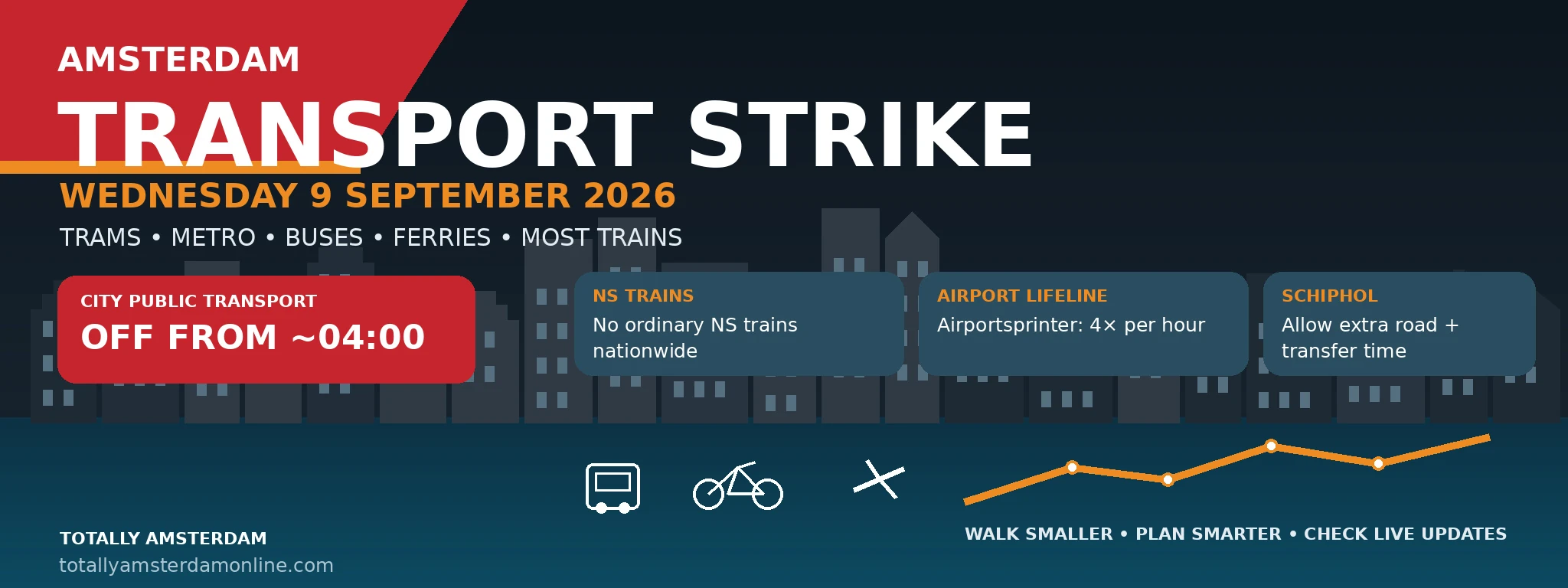
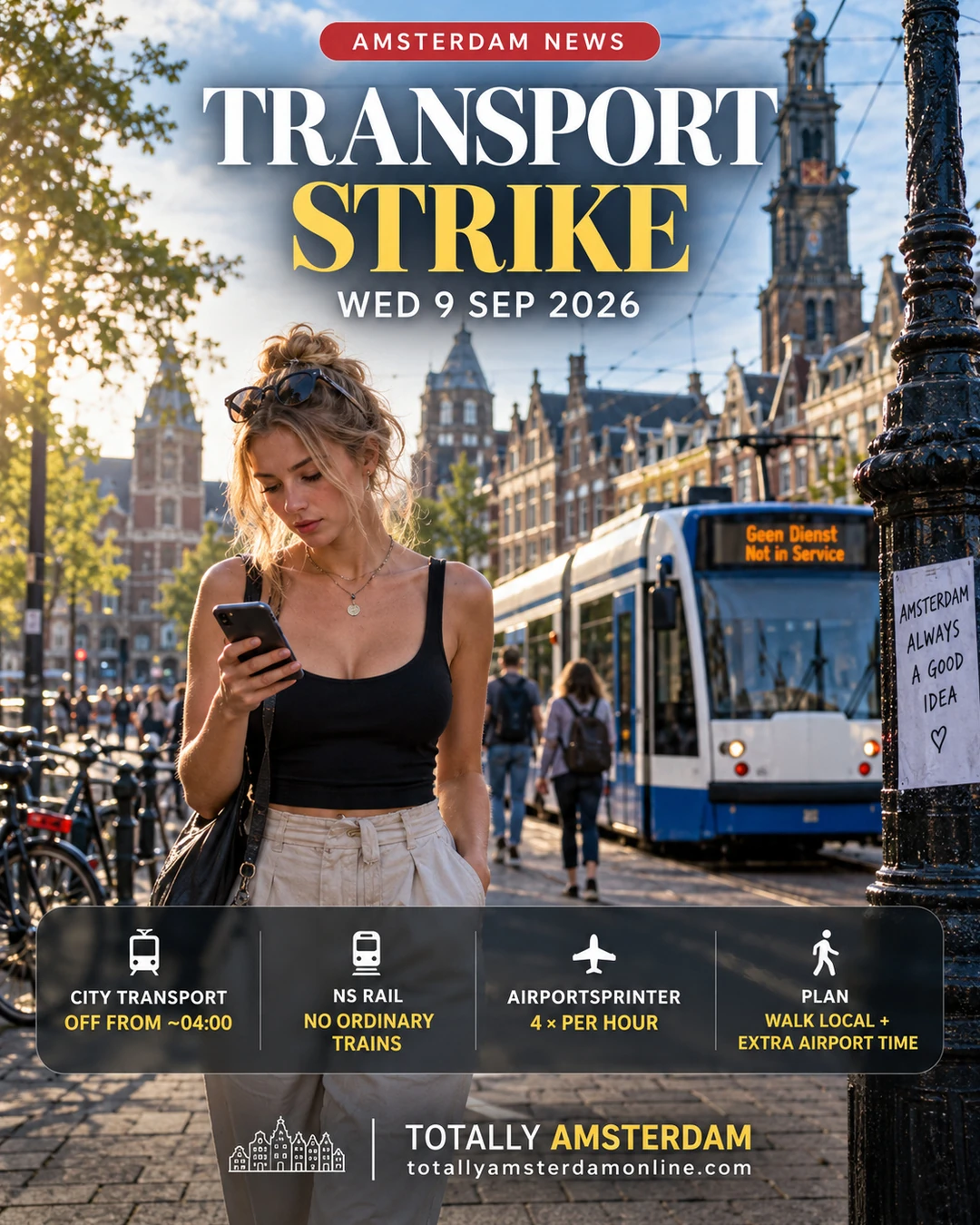
Wednesday 9 September is a public-transport shutdown day in Amsterdam. GVB says its trams, metro, buses and ferries will not operate from around 04:00 for the rest of the day. NS says no ordinary trains will run anywhere in the Netherlands. The key exception is the Airportsprinter between Amsterdam Centraal, Schiphol and Hoofddorp, running four times an hour. If your plan depends on public transport, rebuild it now rather than hoping the strike becomes a reduced timetable.
What exactly stops in Amsterdam?
The strike is nationwide and lasts 24 hours, but the practical start time depends on the operator. In Amsterdam, GVB says its city services stop from about 04:00 on Wednesday 9 September. That means no regular GVB trams, metro trains or buses for the rest of the day. GVB's Service & Tickets locations are also closed.
The city's ferries are part of the strike too. GVB says the Noordzeekanaal ferries and IJ ferry F3 at Buiksloterweg make their final crossings at around 04:00, after which no ferries operate during the day. For a visitor staying in Amsterdam-Noord, that matters as much as the tram shutdown: the usual free hop across the IJ disappears.
NS has gone further and announced that no ordinary NS trains will run anywhere in the Netherlands on 9 September. This is not merely an Amsterdam problem. Day trips to Haarlem, Utrecht, Leiden, Rotterdam, The Hague, Zaanse Schans connections and most other rail-based plans should be treated as unavailable unless the relevant operator explicitly confirms an exception.
The Schiphol exception: one train route still runs
There is one extremely important exception for airport travellers. NS says the Airportsprinter between Amsterdam Centraal, Schiphol Airport and Hoofddorp will run four times per hour. Schiphol repeats that advice and says the airport will be harder to reach from 02:00 on 9 September until 02:00 on 10 September.
Do not read that as “airport transport is normal”. It is not. Schiphol says other forms of public transport such as tram, metro and bus will not operate, and it expects extra road congestion because many passengers will switch to cars and taxis. The airport specifically advises travellers to check the NS journey planner before leaving and, where practical, use the trains that are still running.
If you are being dropped off, Schiphol suggests Amsterdam Centraal, Sloterdijk, Lelylaan or Hoofddorp as possible places to connect onward by the remaining rail service, depending on the live journey planner. If you drive all the way to the airport, allow extra time for road congestion and follow airport signs for Kiss & Ride or P1.
Flying on 9 September: separate the flight from the trip to the airport
The strike is a ground-transport disruption, not an announcement that Schiphol itself is closed. Your flight may still operate. The weak link can simply be getting to the terminal on time — or getting from the terminal into Amsterdam after you land.
My practical sequence would be: check the airline first, then Schiphol's live travel notice, then the NS journey planner. If the Airportsprinter suits your route, protect a generous margin because demand will be concentrated on the one rail service still operating. If it does not suit, compare a taxi, pre-arranged transfer or car rather than assuming the airport bus will rescue the plan.
For arrivals, the same logic runs in reverse. Do not land, discover the city transport network is dark and then begin improvising with luggage. Know before take-off whether you are taking the Airportsprinter, taxi or another road option from Schiphol.
International trains are hit as well
Visitors arriving from London, Paris, Brussels or Germany should not assume an international train bypasses a Dutch domestic strike. NS says EuroCity, EuroCity Direct, Eurostar, NightJet and ICE services will not run in the Netherlands on 9 September. Eurostar's own travel updates show strike-related cancellations and skipped Amsterdam/Rotterdam stops around 8–10 September.
If you hold an international rail booking, check the operator's live disruption page for your exact train number rather than using the normal timetable. Some disruption extends beyond the calendar day of the strike because rolling stock and crews have to be repositioned.
Amsterdam-Noord: no IJ ferry, and the IJ tunnel is not a pedestrian fallback
The City of Amsterdam has highlighted the impact on Noord specifically. With the ferries stopped, the municipality says the IJ tunnel will not be opened to pedestrians, cyclists, brommobiles or similar slow traffic because it considers that unsafe.
The city points cyclists and pedestrians toward the Schellingwouderbrug as an alternative crossing, while warning that it can mean a substantial detour. That is useful if you genuinely need to cross the water, but it is not a convenient substitute for the two-minute ferry ride behind Centraal.
For tourists, the simpler answer may be to redesign the day around the side of the IJ where you are already staying. A Noord hotel day does not need to become a heroic cross-city expedition just because the original itinerary had Museumplein booked at 10:00.
If you are already staying centrally, make the strike day smaller
Amsterdam is unusually well suited to a low-transport day. The historic centre, Jordaan, Nine Streets, canal ring and much of the museum district are walkable if your mobility and the weather allow it. A smart strike-day itinerary is therefore not “find a replacement vehicle for every tram”. It is “compress the geography”.
Pick one walkable cluster, book only what you can comfortably reach on foot, and leave extra time between reservations. If you are an experienced urban cyclist, a rental bike may help for some journeys — but expect more pressure on bike availability and busier roads, and remember that the IJ tunnel does not become a cycling shortcut during the ferry shutdown.
Taxis remain an airport-recommended alternative, but I would not build an eight-stop sightseeing day around them. Demand is likely to spike, roads around Schiphol and central Amsterdam may be busier, and dynamic pricing or long waits can turn “I'll just Uber it” into the most expensive sentence of the day.

What I would postpone completely
Rail day trips are the obvious casualty. If you planned Haarlem, Utrecht, Delft, Rotterdam, The Hague, Alkmaar or another city by train, move that day unless the operator for your exact route publishes a working alternative.
Tight airport connections also deserve a rethink. The Airportsprinter exception is useful, but it is carrying a much larger burden than normal. Do not plan a museum morning that ends with a sprint to Centraal and a zero-buffer airport transfer.
Noord-dependent plans should be checked carefully because the usual ferry network is gone. And any attraction with a timed ticket should be approached from the transport reality backwards: if you cannot reach it comfortably, contact the venue rather than turning the day into an endurance test.
When does service come back?
GVB says the strike ends during the night of 9 to 10 September. From 00:30 on Thursday 10 September, the Noordzeekanaal ferries, IJ ferry F3 and night buses N85 and N87 are due to resume. The other IJ ferries, buses, trams and metro services are expected to return to their normal Thursday timetable in the morning.
NS says it expects the regular train timetable to resume on Thursday 10 September, but it still tells travellers to check the journey planner shortly before departure. That is sensible: a network can be “back” while the specific train you want is still being repositioned or adjusted.
Why are transport workers striking?
The labour action is being organised by unions including FNV and CNV. Their stated focus is opposition to planned Dutch government cuts to social-security protections, including WW unemployment and WIA disability-related arrangements; the unions are also involved in separate collective-agreement disputes in parts of the transport sector.
For visitors, the political argument is secondary to the operational result: unions and operators are all telling passengers to expect a genuine shutdown rather than a token protest. The useful response is to change the travel plan, not debate whether a favourite tram might somehow appear.
A practical visitor plan for Wednesday 9 September
- Move day trips. Assume national rail is unavailable unless your exact operator says otherwise.
- Cluster the Amsterdam day. Choose one walkable district instead of criss-crossing the city.
- If flying, protect the airport margin. Check the four-per-hour Airportsprinter and expect heavier road traffic.
- If staying in Noord, plan for no ferry. Do not assume the IJ tunnel is a walking/cycling alternative.
- Check international rail separately. Eurostar and other international services have strike-related cancellations or route changes.
- Recheck on the morning itself. Use official operator pages, not a screenshot from a travel group posted the day before.
Bottom line
Wednesday 9 September is a day to simplify Amsterdam. The city itself is not closed, but the transport system that usually stitches it together is largely off. Walk where you can, move intercity plans, treat the Airportsprinter as a limited airport lifeline rather than normal service, and do not depend on the IJ ferries.
The upside is that Amsterdam is compact enough to still have a very good day without riding half the network. The downside is that this is not the day for a five-neighbourhood checklist and an optimistic airport connection.
GVB — Amsterdam tram, metro, bus and ferry shutdown details and restart times.
NS — nationwide rail shutdown and Airportsprinter exception.
Schiphol — airport access, road-congestion advice and remaining train service.
City of Amsterdam — ferry shutdown, IJ tunnel restriction and Schellingwouderbrug alternative.
Eurostar — strike-related international rail changes.
FNV — union strike timing and stated reason for the action.
This article reflects official information checked on 7 September 2026. Strike operations can still change. If a newer operator notice conflicts with anything above, the newer official notice wins. Written by the Totally Amsterdam Team.