
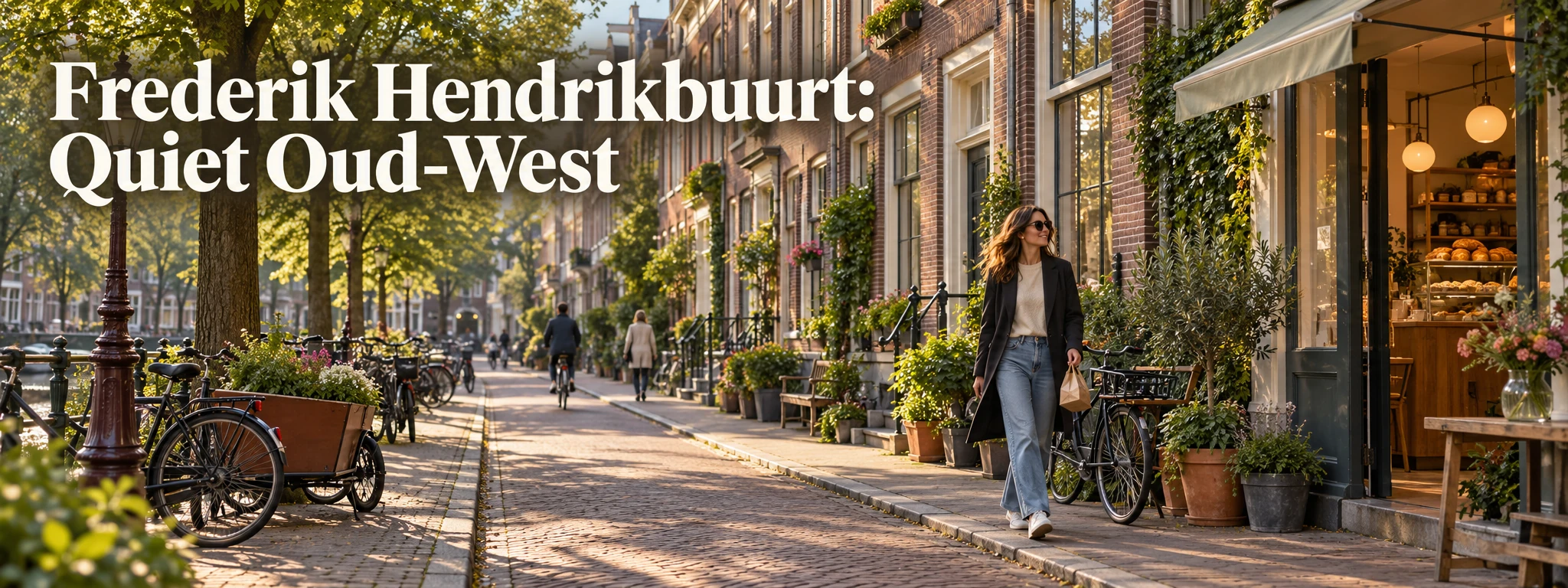
Frederik Hendrikbuurt is one of those Amsterdam neighbourhoods that makes more sense once you stop trying to turn every hour into a checklist. It sits in Amsterdam West, within the city's Westerpark area, immediately west of the Jordaan side of the centre. That geography matters because older visitor descriptions often lump it casually into Oud-West. It is close enough to combine with Oud-West, but it is not simply an extension of the Foodhallen district.
For travellers, the appeal is straightforward: this is a lived-in neighbourhood of residential streets, canals, small shops and everyday cafés rather than a district built around a single famous attraction. It works well as a quieter walking link between central Amsterdam, the Jordaan, Westerpark and the busier parts of West. If you want Rijksmuseum-scale sightseeing, go elsewhere. If you want to understand how the city feels once the attraction density drops, Frederik Hendrikbuurt earns its place.
First: where Frederik Hendrikbuurt actually is
Amsterdam's own neighbourhood data places Frederik Hendrikbuurt in stadsdeel West and in the Westerpark area. The district includes northern, south-western and south-eastern sections, with streets such as Frederik Hendrikstraat, Eerste Hugo de Grootstraat, Hugo de Grootkade and Van Oldenbarneveldtstraat forming part of the local fabric.
That puts the neighbourhood in a useful transition zone. Head east and you are soon approaching the Jordaan and the western canal belt. Head north-west and Westerpark becomes the obvious next stop. Head south and you can continue toward the Kinkerstraat/De Hallen side of West. This is why I think of Frederik Hendrikbuurt as a connector neighbourhood rather than a standalone attraction precinct.
Come here if: you want a quiet hour, local streets and an easy link between Jordaan/Westerpark/West. Skip it if: your Amsterdam time is very limited and you still have major museums, canals or your first Jordaan walk to do.
What the neighbourhood is actually good for
The strongest reason to walk Frederik Hendrikbuurt is contrast. Amsterdam's central districts can be intensely busy, especially around major museum entrances, Damrak, the Red Light District, Nine Streets and the best-known Jordaan lanes. Here the rhythm drops. You are more likely to notice front gardens, school traffic, locals on bikes, ordinary grocery runs and neighbourhood terraces than tour groups following a fixed route.
That makes it particularly useful for repeat visitors, longer stays and anyone staying in West who wants an easy local walk without planning a formal excursion. It is also a good reset between more structured activities: museum in the morning, quiet neighbourhood lunch or coffee, then Westerpark or the Jordaan later.
Frederik Hendrikplantsoen is the obvious anchor
Frederik Hendrikplantsoen gives the neighbourhood a practical centre of gravity. You do not need to treat the park as a major sightseeing stop; it is better understood as green breathing space and a simple orientation point. If you arrive by public transport, this is also a sensible place to start before wandering rather than trying to follow a rigid attraction-by-attraction route.
Current GVB service makes the Frederik Hendrikplantsoen stop useful, although Amsterdam West has substantial tram works and route changes through 2026–27. Tram 12 currently runs via Frederik Hendrikplantsoen, and GVB explicitly advises checking the live journey planner because works can alter routes. That is more reliable than memorising an old tram number from a travel article.
A simple 60–90 minute neighbourhood walk
You do not need a precision route here. Start around Frederik Hendrikplantsoen, then let Frederik Hendrikstraat and the surrounding residential side streets do the work. Drift toward the Hugo de Groot side, cross or follow the canals where the streets invite it, and use a café or bakery stop as the midpoint rather than searching for a 'must-see'.
The useful rule is to keep the walk compact. Once you start racing across West to collect landmarks, you lose the reason for coming. Give yourself about an hour if you simply want the atmosphere, or closer to ninety minutes if you plan to sit down for coffee or lunch. Photographers will probably take longer because the appeal is in ordinary streetscapes, bridges, façades and quiet canal edges rather than one hero shot.
How to combine it with the Jordaan
This is one of the best combinations for a first or second visit because the contrast is immediate. The Jordaan has stronger visitor pull, prettier headline canals and much more obvious sightseeing. Frederik Hendrikbuurt is the decompression zone next door.
A sensible sequence is Jordaan first, especially if you want its markets, canal streets or Anne Frank House area, then walk west when the central foot traffic starts to feel repetitive. You are not travelling to a separate destination; you are allowing the city to become more residential as you move outward. Reverse the route if you are staying in West and want a calm start before entering the centre.
How to combine it with Oud-West and De Hallen
Frederik Hendrikbuurt and Oud-West pair naturally, but they should not be described as the same neighbourhood. Oud-West has the higher-profile De Hallen/Foodhallen axis and a denser visitor food-and-shopping scene. Frederik Hendrikbuurt is quieter and sits further north.
If Foodhallen is on your list, treat it as the busier end of a West-side outing rather than the definition of Frederik Hendrikbuurt. Eat or browse around De Hallen, then continue north for calmer streets — or do the quiet walk first and finish somewhere with more dining choice. That gives the day shape instead of spending two hours in very similar commercial streets.
Who should stay around here?
The area can suit travellers who value residential calm more than being outside a landmark. You remain close enough to central Amsterdam to walk or use trams, but evenings can feel noticeably less tourism-driven than the canal belt. Couples, repeat visitors, remote workers and longer-stay travellers may appreciate that balance.
There are trade-offs. If your priority is stumbling out of the hotel directly into major nightlife, museum squares or a dense cluster of first-time attractions, this is not the most convenient base. If you enjoy starting and ending the day somewhere that feels like a neighbourhood rather than an entertainment district, it becomes more attractive.
Food, coffee and shopping: keep expectations local
Do not come with a checklist of famous venues. The useful food experience here is precisely that the commercial streets serve residents first. Look for busy local cafés, bakeries and casual restaurants rather than chasing a single viral recommendation that may date quickly. Frederik Hendrikstraat and the streets around the plantsoen are sensible places to browse.
For a much wider choice, the Jordaan and Oud-West are close enough to make restaurant planning easy. I would use Frederik Hendrikbuurt for a spontaneous coffee, lunch or neighbourhood drink, then make any high-demand dinner reservation elsewhere if there is a particular Amsterdam restaurant you care about.
Accessibility and mobility
The neighbourhood is mostly useful as an outdoor street-level experience, which makes it easier to adapt than a route built around historic interiors. Amsterdam footpaths can still be narrow or uneven, bikes remain an important hazard at crossings, and canal bridges may introduce gradients. Travellers using wheelchairs or mobility aids should plan the broadest practical route rather than assuming every picturesque side street is equally comfortable.
Public transport conditions in West can change during major works. Check GVB immediately before travel, especially if you rely on a specific low-transfer route. If walking is comfortable for you, the neighbourhood's position between other visitor areas is its biggest advantage: you can simply enter or leave the walk whenever your energy level changes.
Best time to visit
There is no ticket window or opening time dictating the visit, so timing is mostly about atmosphere. Late morning works well if you want cafés open and ordinary neighbourhood activity without an evening focus. A dry late afternoon can be lovely for a slow walk before dinner. In winter, use daylight sensibly; in summer, the area is useful when you need somewhere less hectic between crowded central stops.
I would not cross Amsterdam solely to see Frederik Hendrikbuurt in heavy rain. Its value comes from walking and noticing small things. On a wet day, prioritise a museum or another indoor attraction and save this for a clearer gap in the itinerary.
Frederik Hendrikbuurt versus other quiet neighbourhoods
Choose Frederik Hendrikbuurt when location is the deciding factor. It is particularly convenient if you are already visiting the Jordaan, Westerpark or Oud-West. Choose somewhere farther out when you deliberately want a half-day neighbourhood exploration rather than an easy city-centre extension.
The neighbourhood does not need to compete with Amsterdam's famous districts. Its strength is that it asks very little of you: no reservation, no timed entry, no complicated route and no pressure to prove you saw something famous. That makes it surprisingly useful in an itinerary already overloaded with things you 'must' do.
My practical verdict
Frederik Hendrikbuurt is not a top-ten Amsterdam attraction, and pretending otherwise would make this guide less useful. It is a good neighbourhood for the exact moment when you want Amsterdam to stop performing for visitors. Use it as a calm bridge between bigger areas, take a coffee break, pay attention to the residential city around you and move on when you are ready.
For first-timers with only a day, the Jordaan and major museums still win. For a three-day trip, a repeat visit or a stay in West, this quiet pocket becomes much easier to justify. The key correction is geographical as much as editorial: Frederik Hendrikbuurt belongs to Amsterdam West's Westerpark area, not simply to Oud-West, and planning it that way makes the surrounding city fit together much more clearly.
Cheers, Carpe Diem & enjoy Amsterdam between the headlines! 🍻⏳🚲
TATS Man
Your cyborg guide to the quieter corners worth understanding.
Fact-checked against current City of Amsterdam neighbourhood data and GVB service information. Last updated: October 2026.