
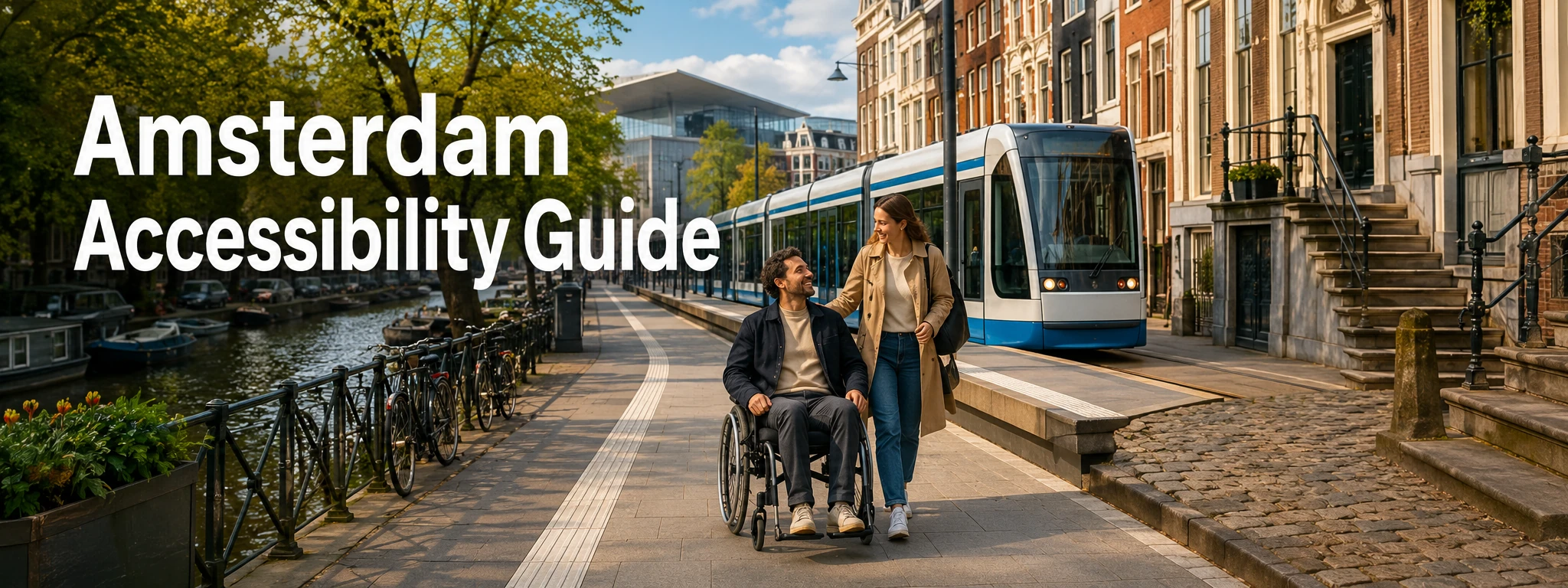
Amsterdam can be an excellent city for travellers with reduced mobility, but it is not uniformly accessible. The flat geography helps; the 17th-century street fabric does not. A realistic plan needs to account for cobbles, narrow pavements, steep canal bridges, historic buildings and occasional lift outages while taking advantage of increasingly accessible public transport and major museums.
Plan the exact journey, not just the destination. GVB's journey planner has an accessibility option and publishes current lift and escalator disruptions. A venue can be fully accessible while the most obvious station exit or tram stop is temporarily awkward.
Amsterdam's main accessibility trade-off
The city is famously flat, which removes the long hills that make some European destinations difficult. The trade-off is surface quality: historic brick and stone, high arched bridges and tight canal-house entrances can turn a short map distance into a tiring route. For wheelchair and rollator users, a slightly longer route along smoother streets may be far better than the “fastest” walking route.
Using GVB with a wheelchair or mobility aid
GVB states that passengers with disabilities can use its public transport and provides an Accessibility Planning option in its journey planner. Use it before setting out. The operator also publishes current lift and escalator disruptions on its website and in the Gappie app, which matters on metro journeys where a single unavailable lift can change the usable station or exit.
GVB's travel rules reserve designated areas for wheelchairs and state that wheelchairs take priority over pushchairs when space is limited. For current route-by-route detail, use GVB's accessible public transport page.
Trams, buses and metro are not identical
Do not assume every vehicle-stop combination offers the same boarding experience. Newer vehicles and upgraded stops are generally easier, while older infrastructure can be less predictable. The accessibility planner is more useful than a blanket statement such as “all trams are accessible”. If a specific journey is critical — for example a timed museum ticket — check it shortly before departure.
Ferries can be a useful low-stress option
The ferries behind Amsterdam Centraal are a practical way to reach Amsterdam-Noord without dealing with a bridge or tunnel on foot. They are part of the everyday transport network and can be an appealing change of scene for travellers who want a relatively simple waterfront outing. See the Amsterdam-Noord guide for what to do after crossing.
Major museums: often the easiest historic-city attractions
Large museums have invested heavily in step-free circulation, lifts and visitor support. I amsterdam maintains current accessibility information for museums, and its wheelchair-accessible museum guidance highlights venues including the Rijksmuseum, Stedelijk and Wereldmuseum. Still check the individual museum's own accessibility page before the visit because entrances, companion policies, loan wheelchairs and temporary gallery closures can change.
Our Rijksmuseum and Van Gogh Museum guides help with the wider visit decision.
The Anne Frank House requires special planning
The historic building contains steep, narrow staircases and cannot be made fully step-free without destroying the structure visitors have come to understand. Do not infer accessibility from the modern entrance alone. Read the Anne Frank House's current official accessibility information before booking if stairs are difficult, and choose an alternative history experience if the physical route is not suitable.
Canal cruises: ask about the exact boat
“Canal cruise” is not one accessibility standard. Boats, docks and gangways differ. Some operators can accommodate wheelchairs on specific vessels or departure points; others cannot. Contact the operator with the dimensions and assistance you need before booking, and get the departure location confirmed. Our canal cruise guide explains the other boat-type trade-offs.
Hotels: the word accessible is not enough
Historic canal houses are beautiful and can be a poor choice for a traveller who cannot manage stairs. Ask the hotel specific questions: Is the route from pavement to room step-free? What are the lift dimensions? Is the shower roll-in? Is there turning space beside the bed? Is breakfast on an accessible floor? A lift in the listing does not guarantee a step-free entrance or an adapted bathroom.
Cobbles, kerbs and canal bridges
Central Amsterdam's bridges often rise more sharply than they appear in photographs. Manual wheelchair users may find repeated crossings tiring, especially in wet conditions. Build fewer canal crossings into the route, use the flatter streets where practical, and allow more time than a standard map estimate suggests.
Accessible toilets
Do not assume every café toilet is accessible; many older businesses have small facilities down narrow stairs. Major museums, stations and modern public venues are safer planned stops. If access to a toilet is a critical part of the day, identify one or two reliable venues in advance rather than improvising.
Travelling with a vision or hearing impairment
Needs vary widely, so check the attraction rather than relying on generic city claims. Major museums may offer audio description, induction loops, tactile resources or companion arrangements, but provision differs by exhibition. GVB also offers assistance information beyond wheelchair access. Contact the venue before a must-see booking if a particular service is essential.
Sensory and cognitive accessibility
Central Amsterdam can be busy with bicycles, trams, bells and dense pedestrian flows. Travellers who find sensory overload difficult may prefer early museum slots, quieter residential neighbourhoods and breaks away from Dam Square or the busiest shopping streets. GVB describes an OV-coach service for people who need support becoming confident with routes, unexpected situations or sensory/anxiety challenges.
Wheelchair-accessible taxis
Accessible vehicles exist, but advance booking is more dependable than hoping the next street taxi is suitable. Explain the chair type and whether you need to remain seated in it during the journey. A hotel can often help confirm a suitable operator, but the booking should still specify the actual accessibility requirement.
Build redundancy into timed-ticket days
If you have a non-flexible museum slot, avoid a route that depends on one lift working at one station. Check GVB disruptions before leaving and know the backup stop or surface route. Arriving early is less stressful than discovering a lift issue with ten minutes left.
A practical accessible day
A lower-friction first day might pair one major accessible museum with a relatively flat Museumplein/De Pijp route, then use tram or taxi for the return rather than adding multiple canal-bridge crossings. Another easy-format day is a ferry to Noord followed by one waterfront attraction and a relaxed return. Good accessible travel in Amsterdam is usually about reducing transitions, not reducing ambition.
Official accessibility sources
Use GVB accessibility information for current transport planning and disruptions, and I amsterdam's wheelchair-accessible museums guide as a discovery tool. For a must-see venue, always finish by checking the venue's own current accessibility page.
This guide is kept accurate and up to date, including transport and venue-access guidance. Last updated: September 2026 — written by the Totally Amsterdam Team.